Case Study: HOSCH Building Automation
Much of our work is no longer visible once a project is completed. This makes it all the more important for us to document the quality of workmanship and construction progress in a transparent manner throughout the entire project. Today, docu tools is an integral part of our quality management system.
Johannes Schaefe
Managing Director and COO, HOSCH Building Automation
Making Quality Visible: How HOSCH Building Automation Uses docu tools to transparently document construction progress and workmanship quality
Executive Summary
HOSCH Building Automation develops and implements sophisticated building automation projects for modern office buildings and functional structures throughout Germany. Especially in technically complex construction projects, success depends not only on professional execution but also on comprehensive documentation and transparent communication. Since 2024, HOSCH has relied on docu tools for this purpose. The software helps the company transparently display construction progress, work quality, and status at any time, provide information centrally, and significantly simplify collaboration with clients and project partners. This ensures that all stakeholders have access to up-to-date information at all times and that clients receive a transparent overview of the project’s progress.
Making Quality Visible
HOSCH Building Automation was founded in 2002 and is one of Germany’s leading vendor-independent system integrators for building automation. Approximately 150 employees at the Teltow, Nuremberg, Hamburg, and Düsseldorf locations design and implement building automation solutions from a single source. The range of services extends from project planning, software engineering, and system integration to switchgear construction, maintenance, and service. The goal is to create environmentally friendly, comfortable, and cost-effective buildings with the lowest possible energy consumption. In this way, HOSCH’s solutions also help reduce CO₂ emissions and advance climate protection in the building sector.
For HOSCH, high quality standards are an essential foundation for sustainable business success. “Our goal is to win customers over in the long term with the quality of our services and thereby lay the groundwork for lasting partnerships with our clients. Transparency and traceable documentation are essential prerequisites for us in this regard,” emphasizes Johannes Schaefe, Managing Director and COO of HOSCH Building Automation.
Many technical installations are hidden behind drop ceilings or in utility shafts as a project progresses. “Much of our work is no longer visible once a project is completed. This makes it all the more important for us to thoroughly document the quality of workmanship and construction progress throughout the entire project. docu tools is now an essential part of our quality management system, ” says Johannes Schaefe.
One platform instead of many individual solutions
Before introducing docu tools, HOSCH used a variety of standalone solutions. Plans were shared via SharePoint, checklists were maintained in Excel, and other information was scattered across various applications. While each solution served its purpose, there was no common platform where all project participants could access the same set of information. “With docu tools, we now work exclusively with a single application. This simplifies our processes considerably, ” Johannes Schaefe sums it up.
Since the first pilot projects, the software has been used regardless of project size. Roles are assigned on a project-by-project basis, tasks are distributed, reports are generated, and all information is documented directly on the digital plans. In addition, HOSCH has customized the software to fit its own workflows. Different colors are used to identify planning documents, construction progress, pre-delivery inspections, or general notes. This allows everyone involved to see at a glance what a specific section is about and what information it contains.
Staying Up to Date Together
On construction sites, it’s crucial that information is up-to-date, unambiguous, and accessible to everyone involved. Outdated drawings or unclear coordination quickly lead to misunderstandings and waste valuable time. “A classic example is having different versions of drawings. In the past, it sometimes happened that someone was still working with an older plan. Today, everyone involved has access to the same up-to-date version. We’ve virtually eliminated this source of error with docu tools,” explains Johannes Schaefe. This also benefits ongoing coordination with clients and project partners. “When we look at a floor plan together, everyone knows immediately what we’re talking about,” he adds.
Clear project information at a glance
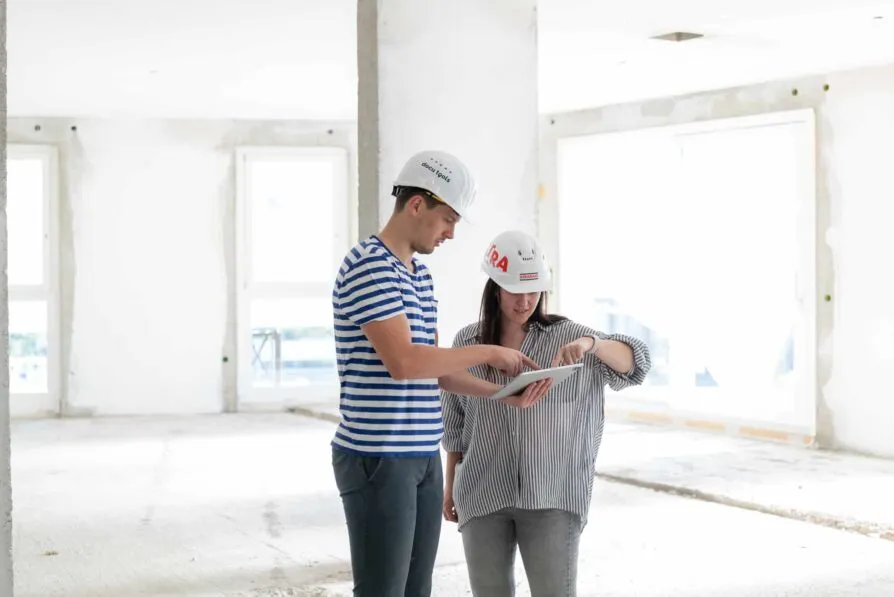
Monika Gorka-Uchman, a construction manager at HOSCH Building Automation, also works with docu tools every day. For her, having a quick overview is crucial, especially on large construction projects. “We work primarily with iPads because they allow us to view the floor plans much more clearly . This is a major advantage, especially for large buildings spanning several thousand square meters. I can see at a glance what preparatory work has been completed and what the current construction progress looks like,” explains Monika Gorka-Uchman.
Another advantage for her is the complete history: “I can go back to the beginning of a project at any time and see how the construction site developed step by step.” This ensures that information remains available even after individual sections have long been completed and technical installations are no longer visible. “Once a ceiling is closed off, no one can see what’s behind it later on. With docu tools, we can track at any time which components were installed there and what the status of the work was at that time. This provides peace of mind, both for us and for our clients,” adds Johannes Schaefe.
Reports at the touch of a button—anytime, anywhere
For HOSCH, a key advantage of docu tools is the ability to quickly and easily create up-to-date reports. Photo documentation, comments, and tasks can be directly compiled into a clear and organized project documentation. “If a client wants to know how far along a particular construction phase is, we can generate a complete report—including photos, comments, and outstanding tasks—in no time at all. This allows us to ensure transparency while saving a lot of time,” explains Johannes Schaefe.
This makes it possible to quickly and systematically consolidate even large amounts of information, especially for larger projects. “Analyses on this scale would have been extremely time-consuming in the past. Today, we can provide the current status practically at the push of a button,” says Johannes Schaefe. For Monika Gorka-Uchman, too, the automatic presentation of project data is a major advantage. “I had expected to have to export the data to Excel first and process it there myself. Instead, docu tools delivers this information already fully processed.”
Transparent Documentation for Successful Collaboration
HOSCH’s clients also benefit from the structured documentation and clear, transparent project communication. Johannes Schaefe sees this as a major advantage for collaboration: “We receive very positive feedback on this form of project communication. Our clients get a transparent overview of the current status in no time at all and can see how structured our work is.” In addition to the software itself, HOSCH also values the direct and reliable collaboration with the docu tools team. “When we need support, we get a response very quickly. The team takes the time to help us, responds promptly, and provides reliable support. We really appreciate that, ” says Monika Gorka-Uchman.
Greater Efficiency Throughout the Entire Project Process
Today, docu tools is an integral part of HOSCH’s daily project work. Documentation, project communication, task management, and reporting all come together on a single platform. This streamlines processes and enables HOSCH to provide clients and partners with a clear overview of project status at any time. “With docu tools, we now work much more efficiently and can present our projects with significantly greater transparency. For companies like ours that place great value on quality, customer focus, and long-term partnerships, the software offers clear advantages in my view, ” summarizes Johannes Schaefe.
About HOSCH
HOSCH Building Automation is one of the leading vendor-independent system integrators for building automation in Germany. Headquartered in Teltow, the company employs approximately 150 people at its locations in Teltow, Nuremberg, Hamburg, and Düsseldorf. Its range of services extends from project planning, software engineering, and system integration to switchgear construction, maintenance, and service. HOSCH supports demanding projects for modern office buildings as well as complex commercial and special-purpose structures, and has relied on docu tools since 2024 to transparently document construction progress, work quality, and project communication.
The most frequently used functions of docu tools
- task control
- plan call
- pin capture
- photo documentation
- documentation maintenance
- Report Generation & Reporting
Facts, figures, and data about the project:
| Industry: | Building Automation / Building Services Engineering (TGA) |
| Project duration: | Depending on the project |
| Company headquarters: | Teltow, Nuremberg, Hamburg, and Düsseldorf |
| Locations | Construction projects throughout Germany |
| Number of employees: | about 150 |
| Number of projects: | 52 |
| Number of pins | 25.000 |
| Number of plans: | 2.100 |
| Use of the Software | Daily involvement in project work, ranging from smaller construction projects to complex large-scale projects such as EDGE East Side in Berlin’s Friedrichshain district or EDGE Friedrichspark |
| Features used: | 7224 |
| Trades involved: | Varies depending on the construction project |
| Project scope: | From smaller construction projects to complex large-scale projects, including modern office buildings as well as commercial and functional buildings |
| Digitalization: | Digital updating of the plant and assembly planning and documentation to be implemented on a shared platform |
| Using docu tools since: | 2024 |
| Areas of application: | Construction documentation, documentation of construction progress and work quality, quality assurance, project communication, task management, and reporting |
| Estimated time saved: | 2–3 days per month |